
How to Make Your Voice Heard at the Texas Capitol
Speak Up. Speak Out. Advocate.
What issues matter most to you this session? Texas House Parliamentarian Chris Griesel explains one of the most basic ways to engage elected officials on those issues: speaking up.

Graphic by Ben Hasson of The Texas Tribune
As lawmakers cross the halfway mark of the 85th Legislature, debate is heating up on a number of issues, including bills that would expand school choice funding, limit increases in college tuition, strip funding from sanctuary cities and regulate public bathroom use based on a person’s “biological sex.”
What issues matter most to you this session? House Parliamentarian Chris Griesel explains one of the most basic ways to engage elected officials on those issues: speaking up. See below for tips from Griesel on how to make your voice heard — an interview that’s been edited for clarity and brevity.
This post is from The Texas Tribune’s Come and Take it Challenge, which encourages readers to learn more about how Texas government works. CLICK HERE to read the full article.
What’s the best way for Texans to be heard on an issue they care about?
Chris Griesel: So let me describe the problem, and then I’m going to tell you a version of the solution. In the next 80 days, 1.8 million pieces of unique communications are going to emanate from Texans into the Capitol. To put that in context, that communication would fill the seats in more than 22 Dallas Cowboys stadiums. I want you to think about all those people in those stadiums yelling at one time. What are the odds of your voice being heard on the stadium floor? It’s signal and noise — how do you get your signal through?
Who should citizens be contacting? What’s the difference between contacting Gov. Greg Abbott, U.S. Sen. Ted Cruz or a state legislator?
CG: The short answer is you can always write to anyone about anything. But if you have limited time, you might want to target your communication at whoever is actually acting next. And you might want to target who can actually help you make the difference you are requesting. When I worked at the Supreme Court of Texas, I answered a lot of phone calls from people upset at what the U.S. Supreme Court had just done. I really couldn’t be much help to people who wanted me to deliver a message to Chief Justice [William] Rehnquist. Also, it is more likely that you will get a better response on the local “filling in the potholes” issues if you talk with your city councilperson or county commissioner rather than a United States senator. As far as I know, Gov. Abbott, Sens. [John] Cornyn and Cruz, and all members of the state Legislature love well-written and well-conceived correspondence.
Does showing up to testify in Austin make a difference? Would it change a lawmaker’s position?
CG: I think that coming down and talking to membership does matter, but I also think it matters that you have that contact. Every bill starts with a story. You’ve got to start that story somewhere, and that is either at a town hall, or when they’re walking and they knock on your door and they want your vote and you stop and you give them five seconds of your time. I do think that personal contact has something to do with it.
But coming to the Capitol is great because one of the things that our committee system does is pop up a card when you appear as a witness. It tells the members what district you are from, and so the members and staff are looking at those cards all the time. The members want to hear your stories. Remember, they’re trapped in Austin, Texas — it’s like being trapped in a very bad high school with marginal food for 140 days. They want to hear stories from back home.
What if someone can’t come all the way to Austin?
CG: You have these opportunities to engage with them not only when they’re in session, but you have a chance to engage with them the 18 months when they’re not in session, and I would fully use that time to get your point across.
Where do you see communication with elected officials going from here?
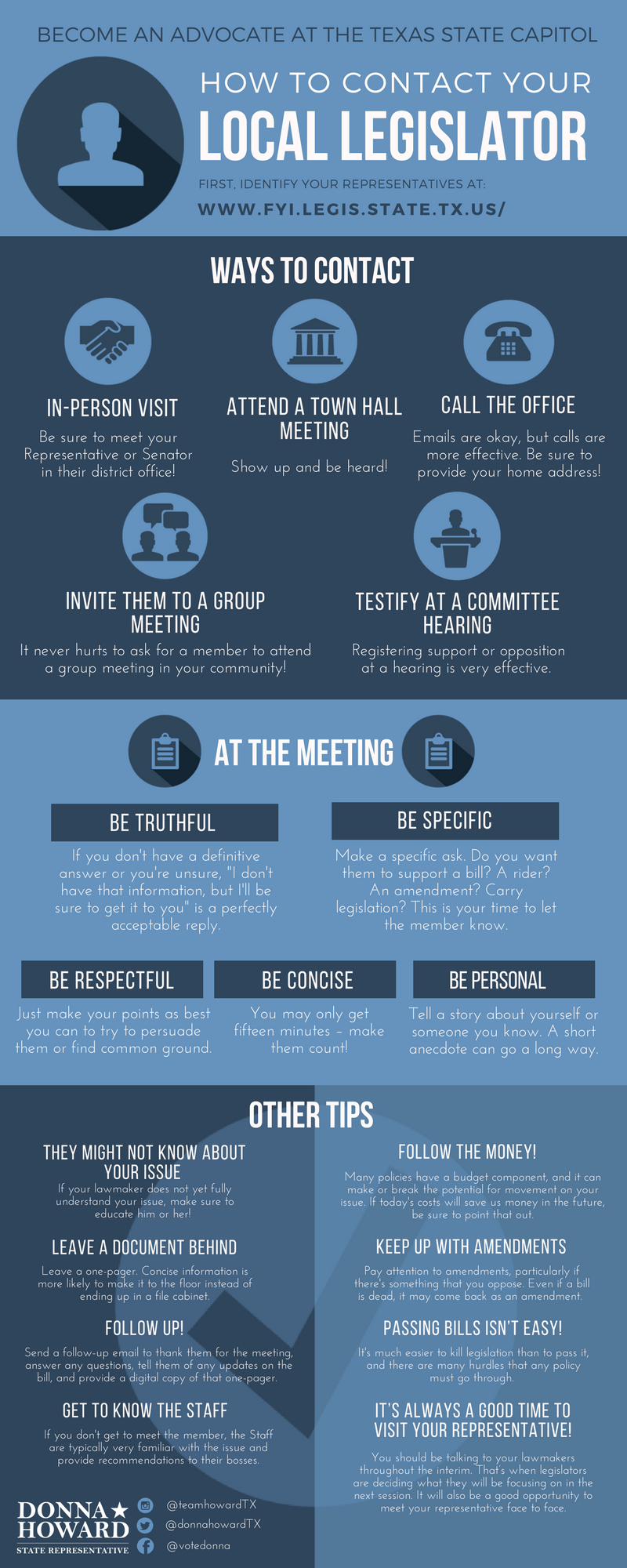
CG: For the last 200 years, members have been reactively responding to constituent concerns. Maybe the future for legislators is having staffers whose sole job is to proactively make it easier for members to reach different audiences or constituencies. … A great example of trying to find the audience rather than merely listening to the audience is a set of two really well done infographics made by a member’s office on how to communicate and testify before the Legislature, that can be easily transmitted in a number of formats and used in almost any group in any every situation. They beat anything I’ve said.
Do you want to learn more about current issues and policy that may affect you, your family, and your business? Join the Plano Chamber at an upcoming Public Policy Committee Meeting or explore the Events Calendar to attend Candidate Forums, Town Halls, and Issue Updates.